AI Agents: Separating the Hype from Empirical Evidence
TL;DR:
- AI agents combine language models with external tools to act autonomously — they are qualitatively different from the chatbots we've been using up to now.
- The empirical evidence is sobering: Princeton studies show that models like Claude Opus 4.5 achieve only 85% overall reliability, and a Fortune article (March 2026) states that "unreliability is the main drawback of current AI agents."
- They are genuinely useful in specific, controlled contexts, but deploying them without proper safeguards exposes organizations to documented risks in security, bias, and loss of operational control.
The Promise vs. the Data
Satya Nadella calls it "one of the most transcendental platform shifts in history." Jensen Huang says AI agents are "the new computer." Kai-Fu Lee predicts that "the basic unit of the company will evolve from a human being to an AI agent."
These aren't statements from snake oil salespeople. They come from the CEOs of Microsoft and NVIDIA, and one of the world's most influential AI investors. And at the same time, Gary Marcus — a researcher who has spent decades documenting the limits of artificial intelligence — writes on his Substack: "despite all the hype, agents didn't turn out to be reliable."
Who's right? The answer, as is usually the case in science, is not binary. Tech journalism that simply amplifies press releases — or reflexively debunks them — does a disservice to anyone who needs to make real decisions. This analysis attempts something different: reviewing the available evidence and drawing conclusions proportional to the data.
What Exactly Is an AI Agent?
Before evaluating the hype, the object of study needs a precise technical definition.
An AI agent is not simply an improved chatbot. The distinction is both technical and conceptually relevant — and conflating them is a mistake made by both proponents and critics of the technology.
A large language model (LLM) like GPT or Claude, in its base form, operates transactionally: it receives text as input and produces text as output. It doesn't persist state between conversations (without explicit memory mechanisms), it cannot execute actions in the external world, and it cannot autonomously plan a sequence of steps to accomplish a complex objective.
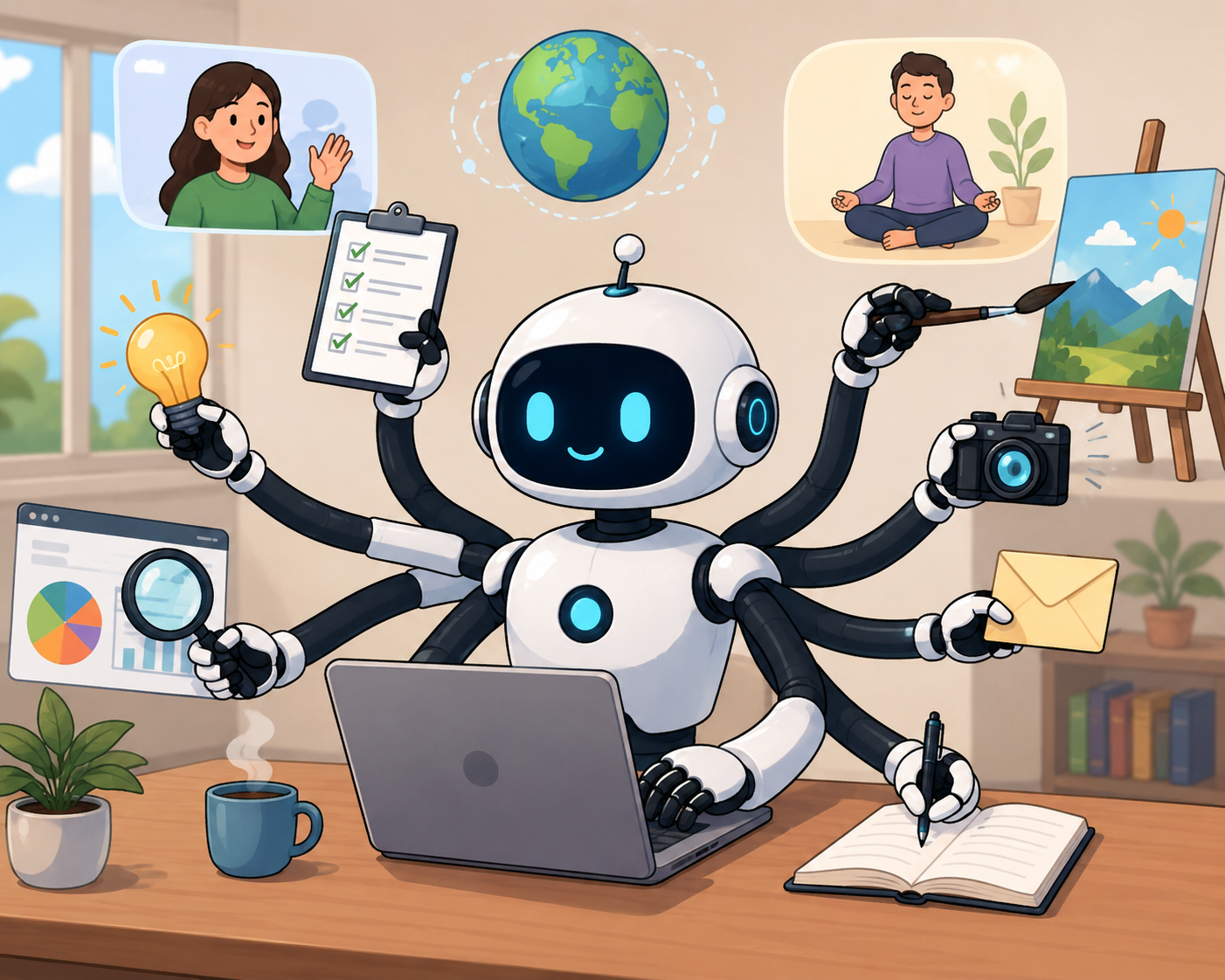
An AI agent adds an architectural layer over that model that enables it to:
- Use tools: access external APIs, perform real-time web searches, execute code, query databases, send emails, or interact with other systems.
- Plan multi-step tasks: decompose complex objectives into subtasks and execute them in sequence, adjusting the plan based on intermediate results.
- Reason about goals: maintain a persistent working state, evaluate progress, and determine when an objective is complete or requires human intervention.
- Act autonomously or semi-autonomously: complete entire workflows without a human approving each individual step.
There is also a particularly consequential variant: sandbox-type agents, capable of executing code in isolated, controlled environments. This allows them to do things no chatbot could: actively debug software, run test suites, modify files, and automate complex operational tasks.
This architecture — LLM as "brain," connectors as "limbs" — is what powers tools like Claude Code, LinkedIn's recruitment agent (projecting ~$450M in annual revenue), and the shopping agent Alibaba integrated into Taobao in May 2026 using its Qwen model.
The Qualitative Leap Beyond LLMs
The difference between an LLM and an agent is not one of degree — it is one of kind.
A classic LLM answers questions. An agent completes missions. When a user asks an agent to "analyze this quarter's pending contracts, flag the risk clauses, and draft a response," the agent doesn't just generate text: it accesses the documents via available tools, processes their contents, evaluates them, drafts the response, and may even send it — all without the user having to intervene at each step.
Nicholas Lin, an executive at Anthropic Financial Services, describes what they're documenting in banking: "Finance is a great model... and we've seen massive acceleration" in the use of agents for analysis, compliance, and workflow automation.
Boris Cherny, also from Anthropic, points to another dimension of the shift: "advanced tools and AI agents already allow product, design, and finance employees to build solutions, prototypes, or automations without deep technical knowledge." This redistributes the ability to build software from a small group of engineers to the broader organization.
Adoption data confirms the change is not hypothetical: 90% of developers already use AI coding assistants daily, and more than 80% of Fortune 500 companies have deployed active agents in business processes.
The Hype: Declarations That Move Markets
The economic commitments of 2026 are concrete and quantifiable, not speculative.
At NVIDIA's GTC in March 2026, Jensen Huang declared that AI agents are unleashing a "new era": "Every company today needs a strategy for this. This is the new computer." NVIDIA launched dedicated tools (NeMo, hardware "architected for agents") and positions agents as the central use case of its platform.
Microsoft, which invested $190 billion in AI by 2026, positions agents as the dominant workload for Azure. Nadella stated that agents "working on behalf of or alongside users have created value." In April 2026, the company announced it would allow customers to create autonomous agents in the cloud.
Google, at Google Cloud Next (April 2026), placed agents at the center of its enterprise strategy. Thomas Kurian stated that the adoption of customized agents on Vertex AI "has exploded" as a use case.
Anthropic signed a $1.8 billion cloud computing deal with Akamai in May 2026 to support demand for its agents and models. That same month, it unveiled 10 specialized agents for the financial sector.
Alibaba announced (Reuters, May 10, 2026) the integration of its Qwen AI into Taobao, allowing users to search, compare, and buy products by chatting with the agent rather than using traditional search. China is moving toward "AI-integrated transactions."
LinkedIn (owned by Microsoft) projects that its recruitment agents will generate ~$450M in annual revenue by filtering candidate profiles based on user instructions.
These are real economic commitments, not ideas. The market isn't betting on a concept; it's betting on infrastructure.
The Empirical Evidence: What the Data Actually Shows
This is where the analysis becomes more interesting — and more sober.
The Reliability Problem
A Princeton University study published in 2026 evaluated the reliability of the most advanced AI agents available. The methodology matters: researchers distinguish between accuracy (does it produce correct answers?) and reliability (is it consistent, safe, and calibrated?). The finding is striking: Claude Opus 4.5 and Gemini 3 Pro showed only 85% overall reliability, with documented consistency problems when presented with identical queries at different times.
The most significant finding: reliability improves far less than accuracy when models are updated. In other words, agents become more "intelligent" in the sense of producing more sophisticated responses, but not necessarily more "reliable" in the sense of being predictable and safe enough for production use.
A Fortune article (March 2026) states it plainly: "unreliability is the main drawback of current AI agents."
Gary Marcus synthesizes the critical position with characteristic rigor: in his 2026 predictions analysis, he documents that agents have systematically underperformed in real-world tasks requiring consistency and reasoning over verifiable facts.
The Generated Code Problem
The Veracode DORA 2025 report adds data on another critical dimension: the quality of code these agents produce. Its findings are concerning: 45% of AI-generated code contains critical vulnerabilities, including outdated cryptography (using MD5 or SHA-1 instead of modern algorithms), dependencies with known vulnerabilities, hardcoded credentials, improper error handling, and insufficient input validation.
98% of companies using AI to generate code have suffered breaches linked to those vulnerabilities. Only 18% have active tools to audit AI-generated code. 81% admit to having deployed "imperfect" code to production.
These data points don't mean AI coding agents are useless. They mean the correct workflow includes mandatory human review, static analysis tools (SAST) integrated into the CI/CD pipeline, and regular security audits.
Are They Actually Useful?
The documented answer is: yes, in specific contexts and with appropriate oversight.
The use cases with the strongest evidence of concrete utility are the following:
Automation of repetitive, structured workflows: LinkedIn estimates its agents cut 50% of repetitive work in recruitment. Oracle's Steve Miranda anticipates automation of routine administrative tasks like data entry, freeing humans for strategic decision-making roles.
Research and information synthesis: "Deep Research agents" can process volumes of documents that would be unmanageable for any human analyst in a reasonable timeframe, producing structured summaries with verifiable references.
First-level customer service and technical support: With appropriate guardrails defining the scope of responses and the cases that require human escalation.
Assisted code generation and debugging: With the critical caveat — backed by Veracode's data — that generated code must be reviewed, audited, and tested before going to production.
Enrique Dans, a professor at IE Business School, captures the nuance that corporate press releases tend to omit: "if you use AI to amplify your judgment, you win; if you use it to replace your judgment, you become dispensable." The value lies in amplifying expert human judgment, not in its uncritical replacement.
Can You Trust Them? The Documented Risks
This is the question most conspicuously absent from Big Tech press releases.
Security: An Amplified Attack Surface
The NIST (National Institute of Standards and Technology) has formally documented that autonomous agents can be "hijacked": through the injection of malicious instructions in prompts, processed documents, or user interfaces, an attacker can cause an agent to reveal confidential information or execute unauthorized actions.
IBM notes that agentic systems have a fundamentally expanded attack surface compared to traditional LLMs: every call to an external API, database, or third-party tool is a potential compromise vector. Documented attack vectors include: prompt injection, manipulation of external tools and APIs, poisoning of the agent's memory, and privilege escalation via compromised credentials.
When agents operate at high speed and coordinate with each other — as in multi-agent architectures — a single point of compromise can amplify the impact exponentially.
The "shadow AI" phenomenon exacerbates the problem: a global study found that 29% of employees use agents without IT department approval, exposing organizations to hidden risks including data exfiltration to external services and agents operating with excessive permissions.
Microsoft has coined the term "double agents" to describe the scenario where an assistant designed to help ends up acting against the organization's interests after receiving malicious or ambiguous instructions.
Reliability: The Problem of Systemic Hallucinations
Beyond external security threats, there is the problem of internal operational reliability. Agents can "hallucinate" — producing incorrect information with apparent confidence — make decisions based on erroneous data, or behave inconsistently when facing the same problem at different times.
Technically sound mitigations recommended by the research community include:
- Keeping humans in the loop for all high-impact decisions
- Implementing programmatic guardrails that define the boundaries of agent action
- Generating auditable logs of all agent actions
- Using model ensembles for cross-validation of critical decisions
- Maintaining hybrid AI-human workflows in tasks where errors have irreversible consequences
Microsoft and Google already incorporate governance and audit mechanisms into their agent frameworks — a signal that the industry acknowledges the problem, even if concrete implementations are still maturing.
Ethics and Employment: The Social Dimension
The European Union is debating specific adjustments to the AI Act to address autonomous agents. The impact on employment is real, asymmetric, and uneven across sectors.
LinkedIn estimates its agents will cut 50% of repetitive recruitment work. Oracle's Miranda anticipates automation of administrative process roles. But new profiles are also emerging: agent maintenance, AI auditing, supervision tool development.
Dans's thesis is supported by the evidence: AI amplifies the gap between those who use it to enhance their judgment and those who use it as a substitute for it.
The Framework Ecosystem
For those who need to evaluate where the technology actually stands, the framework ecosystem is a useful maturity indicator.
| Framework | Type | Maturity | Best for |
|---|---|---|---|
| LangGraph | Python library | New (v0.x, 2026) | Graphical orchestration of complex workflows |
| CrewAI | Python framework | Active (50k★ GitHub) | Multi-agent teams with collaborative roles |
| Semantic Kernel | .NET/Python SDK (MS) | Mature (v1.x) | Modular agents in Microsoft environments |
| OpenAI Agents SDK | Python/JS SDK | Active (v0.x) | Conversational agents with native guardrails |
| Claude Agent SDK | Python/Node SDK | New (v1.x) | Agents built on Anthropic/Claude models |
| LlamaIndex | Python/TS framework | High adoption (~25M downloads) | Information agents and RAG over documents |
A structurally important data point: nearly all of them are MIT-licensed. The technological barrier to entry is low. The barrier to secure, reliable, and audited deployment is high. The fact that any developer can build an agent in a few hours does not mean they are in a position to deploy it to production without significant risk.
Future Outlook
The data analysis from the industry allows for three plausible horizons, each with different levels of uncertainty:
2027 (1 year): Maturation of enterprise agents in finance automation, customer support, and software development. First specific regulations on the security and ethics of autonomous agents. Incremental reliability improvements, with greater integration into standardized cloud services.
2029 (3 years): Agents as stable digital collaborators in medicine, finance, education, and manufacturing, conducting complex analyses under human supervision. Consolidated public-labor debate on technological unemployment. Possible security certifications for agents deployed in critical sectors.
2036 (10 years): Agents omnipresent in daily life and corporate operations. Global governance over autonomous systems (international treaties, audit standards). The majority of routine cognitive tasks automated, with new social and labor structures that we cannot yet predict with precision.
The 10-year horizon is inherently speculative. What is not speculative: the direction of change is established, and the world's largest economic actors have made concrete financial commitments in that direction.
Conclusion: Hype with Substance, but Real Technical Debt
After reviewing the available evidence — not press releases, but Princeton studies, NIST reports, Veracode data, and real adoption figures — the conclusions are as follows:
AI agents are qualitatively different from the LLMs we had before. The ability to plan, use tools, and execute autonomous actions represents a genuine architectural leap. It's not just marketing.
They are useful in specific, well-defined contexts: repetitive task automation, information synthesis, code generation with human oversight, customer service with a defined scope.
They are not reliable at the level required by critical decisions. 85% overall reliability may be acceptable for e-commerce purchase suggestions; it is unacceptable for medical diagnostics or high-impact financial decisions.
The risks are documented and quantifiable: NIST categorizes them, Princeton measures them, Veracode quantifies them in compromised code.
The right question isn't "are AI agents a revolution or just hype?" The right question is: for which specific use case, with which controls, with what level of human oversight? That is the only way to evaluate this technology with rigor.
Those who make adoption decisions based on CEO declarations without reviewing the reliability studies and security frameworks will, at best, underutilize the technology. At worst, they'll expose their organizations to risks that the evidence has already documented.
Primary sources: Analytical Report on AI Agents (May 2026); Report on AI Code-Generating Agents (2026); Princeton studies on model reliability; Veracode DORA 2025; Fortune (March 2026); NIST; Reuters (LinkedIn, Anthropic-Akamai, Meta, Alibaba, NVIDIA GTC); Google Cloud Next (April 2026); official OpenAI and Anthropic statements.
Tincho Fuentes — Tech journalist and investigative researcher 🚀